Convert 3MF
to Parasolid.
Updated 2026-10-19
To convert 3MF to Parasolid, drop the .3mf into the converter below and download an .x_t solid for SOLIDWORKS, Solid Edge or NX. Planes, cylinders, cones, spheres and tori in the mesh are usually rebuilt as true surfaces, so a hole comes back as one cylindrical face you can measure; where none of them fits, the region stays faceted and the download says which you got. No account is needed for up to 2 solid conversions a day.
2 solid-geometry conversions a day with no account. No card, no install.
On our servers. No account: deleted within 24 hours. Signed in: kept until you delete them. Never shared or used for training.
Planes, cylinders, cones and spheres are rebuilt as true surfaces where the triangles fit them, and freeform regions as smooth patches, in a closed solid that mates, measures and cuts like modelled geometry. Where they cannot be rebuilt the body is faceted instead, and every conversion says which of the two you got.
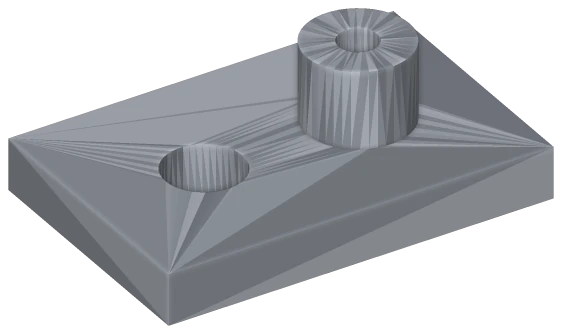
One face per triangle · 524 faces. Each hole is a ring of flat strips you cannot select or measure.
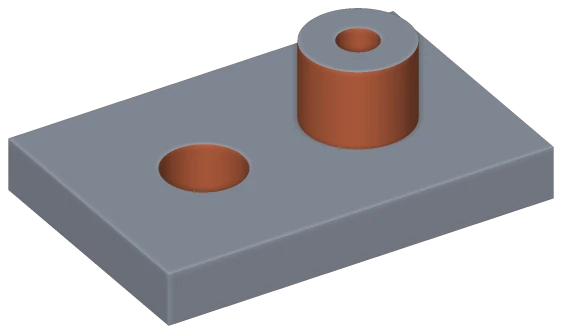
MeshWeave · 10 faces: 7 planes and 3 cylinders. The hole measures Ø12.00 mm.
Surfaces are only as accurate as the mesh they come from, and there is no feature history.
What changes between 3MF and Parasolid
A 3MF is a print file: a triangle mesh with its unit recorded, often with colours and several objects. A Parasolid file is an exact solid; going from one to the other means recovering the surfaces the triangles approximated, and some regions have none to recover.
Regions that lie on a plane, cylinder, cone, sphere or torus are fitted and accepted only when every vertex of the region lies close to the fit; they become true faces, joined into a closed body. Regions that fit none of those become smooth patches or stay faceted, and a coarse mesh gives coarse surfaces, so export the 3MF at the finest setting you can.
What does not travel: print settings, colours and materials, supports and anything else the slicer added. If the 3MF came from a CAD model, the original CAD file or a STEP export of it will always be more accurate than surfaces recovered from its mesh, so ask for that first.
- Drop your .3mf file above — up to 200 MB without an account.
- Parasolid is already selected as the output.
- Download the .x_t. Without an account, files are deleted within 24 hours; signed in, they are kept until you delete them.
3D Manufacturing Format file (.3mf)
3MF was designed to replace STL for 3D printing. It records units, colour and material, keeps multiple objects separate, and is compressed. Bambu Studio, PrusaSlicer, Cura and Windows all read it. The shape is still a triangle mesh.
You are printing and want units, colour and part structure to survive the handover.
Parasolid transmit file (.x_t / .x_b)
Parasolid is the modelling kernel under SOLIDWORKS, Solid Edge and NX, and a transmit file is its exact solid geometry. Between systems that share the kernel it often survives better than a neutral format. .x_t is text, .x_b is binary; both hold the same solid.
Someone in a Siemens or SOLIDWORKS shop sent you an .x_t and nothing you have opens it.
Can I get the original CAD model back from a 3MF?
Do I get an .x_t or an .x_b?
Will a hole in the print file become a real hole?
Should I convert to STEP instead?
Is the 3MF to Parasolid converter free?
Does the Parasolid result have real curves, or flat facets?
Will the Parasolid file open in Fusion 360, Inventor or Onshape?
How big a file can I convert?
Is it safe to upload my 3MF file?
Is my 3MF file deleted after converting?
Keep the part open: fill it with a lattice, check it with FEA, texture a surface, or slice it into cut-ready sheets. These workspaces are in early access — create an account, then apply from inside the app.
Convert 3MF to something else
Going the other way? Convert Parasolid to 3MF.
Parasolid® is a registered trademark of Siemens. MeshWeave is an independent tool and is not affiliated with, endorsed by, or sponsored by Siemens.