Convert OBJ
to STEP.
Updated 2026-10-19
To convert OBJ (.obj) to STEP (.step / .stp), drop the file below and download the result, in the browser with nothing installed. The mesh comes back as a STEP solid with real surfaces: a round hole becomes one cylindrical face.
2 solid-geometry conversions a day with no account. No card, no install. In your browser too: real surfaces, no daily limit, the file never uploaded.
On our servers. No account: deleted within 24 hours. Signed in: kept until you delete them. Never shared or used for training.
Planes, cylinders, cones and spheres are rebuilt as true surfaces where the triangles fit them, and freeform regions as smooth patches, in a closed solid that mates, measures and cuts like modelled geometry. Where they cannot be rebuilt the body is faceted instead, and every conversion says which of the two you got.
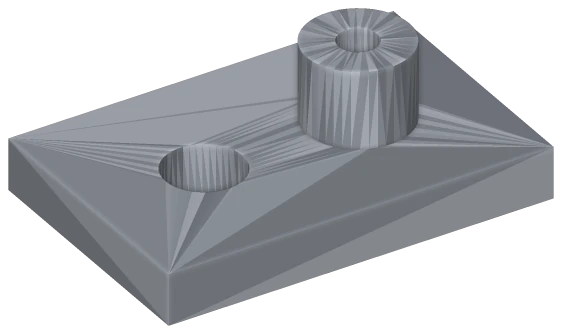
One face per triangle · 524 faces. Each hole is a ring of flat strips you cannot select or measure.
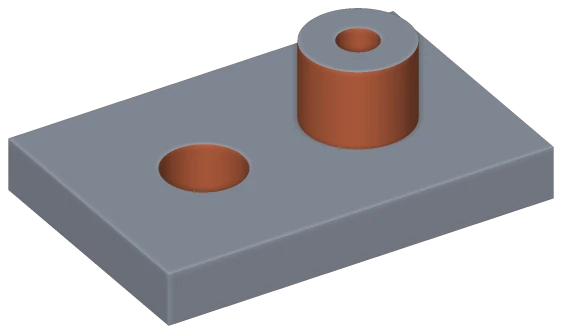
MeshWeave · 10 faces: 7 planes and 3 cylinders. The hole measures Ø12.00 mm.
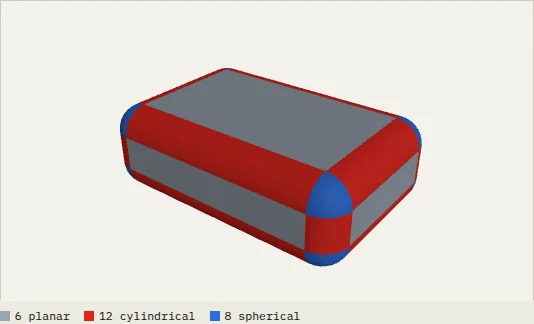
Box, R3 fillets on every edge · 9,452 triangles to 26 faces: 6 planar, 12 cylindrical, 8 spherical. 1.1 s.
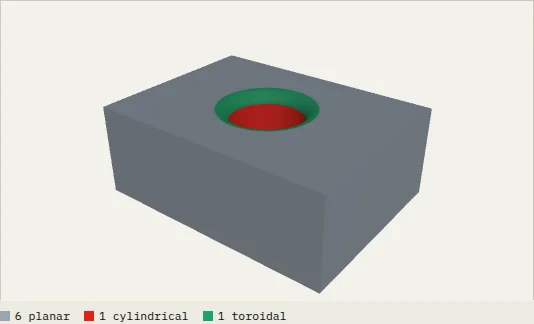
Block with a bore and a rim fillet · 8,584 triangles to 8 faces: 6 planar, 1 cylindrical, 1 toroidal. 403 ms.
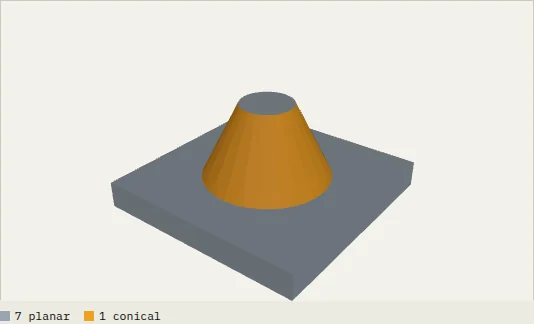
Cone on a plate · 1,272 triangles to 8 faces: 7 planar, 1 conical. 125 ms.
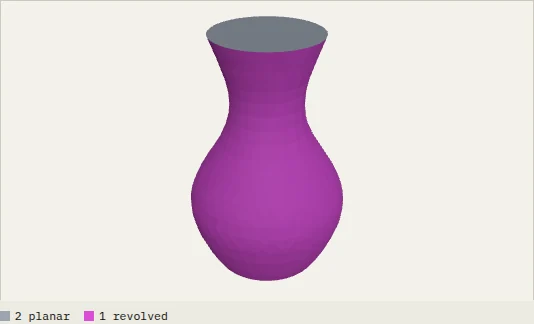
Vase, freeform profile · 9,088 triangles to 3 faces: 2 planar, 1 revolved. 874 ms.
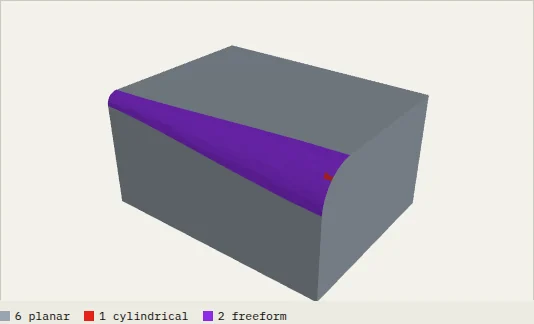
Variable-radius blend, 2 to 6 mm · 2,602 triangles to 9 faces: 6 planar, 1 cylindrical, 2 freeform. 628 ms.
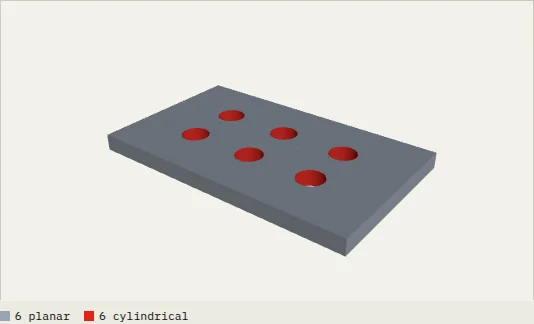
The plate sample · 1,188 triangles to 12 faces: 6 planar, 6 cylindrical. 119 ms.
Surfaces are only as accurate as the mesh they come from, and there is no feature history.
- Drop your .obj file above — up to 200 MB without an account.
- STEP is already selected as the output.
- Download the .step. Without an account, files are deleted within 24 hours; signed in, they are kept until you delete them.
Wavefront OBJ file (.obj)
OBJ is a plain-text mesh format from graphics. Unlike STL it keeps named groups, texture coordinates, materials and polygon faces, which makes it the usual handover into rendering and texturing tools. It is still a mesh, not a solid.
The destination is a renderer, game engine, texturing tool or visualisation pipeline.
STEP file (ISO 10303) (.step / .stp)
STEP (ISO 10303) is the closest thing engineering has to a universal solid format. It stores exact B-rep geometry — a hole is a cylindrical face, not a ring of facets. Fusion 360, Inventor, Onshape, SOLIDWORKS, Creo, NX, CATIA and FreeCAD all read it; .step and .stp are the same format. AP242 supersedes AP203 and AP214.
What you send when the other side has to keep modelling, quote machining, or open the shape in a different CAD system.
Is the OBJ to STEP converter free?
Does the STEP result have real curves, or flat facets?
Will the STEP file open in Fusion 360, Inventor or Onshape?
How big a file can I convert?
Is it safe to upload my OBJ file?
Is my OBJ file deleted after converting?
Keep the part open: fill it with a lattice, check it with FEA, texture a surface, or slice it into cut-ready sheets. These workspaces are in early access — create an account, then apply from inside the app.
- STL to STEP with true surfaces — You have an STL and someone needs a STEP.
Convert OBJ to something else
Convert something else to STEP
Going the other way? Convert STEP to OBJ.